
Criminal Cases in San Benito County Courts
The Superior Court of California, County of San Benito handles local felonies, misdemeanors, traffic matters, and ordinance citations. Its Main Courthouse and Criminal/Traffic Division are at 450 Fourth Street in Hollister. The division uses 831-636-4057, option 3, and the clerk counter is open Monday through Friday from 8:00 a.m. to 3:30 p.m., except court holidays.
Hollister and San Juan Bautista do not keep separate municipal criminal dockets. A city police arrest may begin with a local report, but charges filed by the District Attorney become a San Benito County Superior Court case. The clerk, not the county clerk or Sheriff's Records Division, is custodian of that judicial file. Case numbers, calendar events, filings, pleas, rulings, disposition, and sentencing records remain with the court.
San Benito Criminal Case Portal
The San Benito Superior Court Public Portal is the first remote channel for public case data and calendars. A user must register and log in to search public case information. The login asks for an email address, password, and a simple CAPTCHA answer. Search fields beyond login are gated, so the court does not promise that every visitor will see the same field set or every case.
The portal is a finding aid. Its disclaimer says the data is not the official court record, may contain errors or omissions, and excludes confidential, sealed, and certain other matters. Only a limited number of cases may appear. PortalAdmin@sanbenitocourt.org handles account trouble only, not questions about a charge, hearing, or case outcome.
| Portal field | Use | Access note |
|---|---|---|
| Register | Create a public account | Needed before a public case search |
| Email and password | Log in | Both are required |
| CAPTCHA | Confirm a human login | Simple math prompt |
| Case or citation data | Locate a matter | Fields appear after login |
| My Cases | Open approved case access | Document rights may be limited |
How to Search Case Records
Use names and case or citation numbers exactly as they appear on court papers. A date of birth can help the clerk distinguish people with similar names, although the public portal's post-login fields were not available for public inspection. The court's portal instructions explain account creation and the boundary between case data and official documents.
- Create or open a San Benito Public Portal account.
- Use the available case, party, or citation fields after login.
- Read the register of actions and calendar as leads, not certified proof.
- Ask the Criminal Division for the disposition or named documents.
- Use the research form for mailed, certified, or off-site copies.
For a traffic citation inquiry, have the citation or case number, driver's license number, and date of birth ready. If the search returns nothing, call the Criminal/Traffic Division instead of assuming no San Benito County court case exists. Spelling, an older file, a confidential status, or an access rule may explain the missing result.
Official San Benito Case Copies
The court's local forms list includes the mandatory SB-MC-3 Criminal History Request. The Research and Copy Request Form supports name searches, document requests, certification, and off-site retrieval. A written request should identify the case or documents, include a check for the total cost, and provide a self-addressed stamped envelope. The clerk mails the documents after those items arrive.
The pictured forms list is useful because it shows the local criminal-history request beside other court forms.
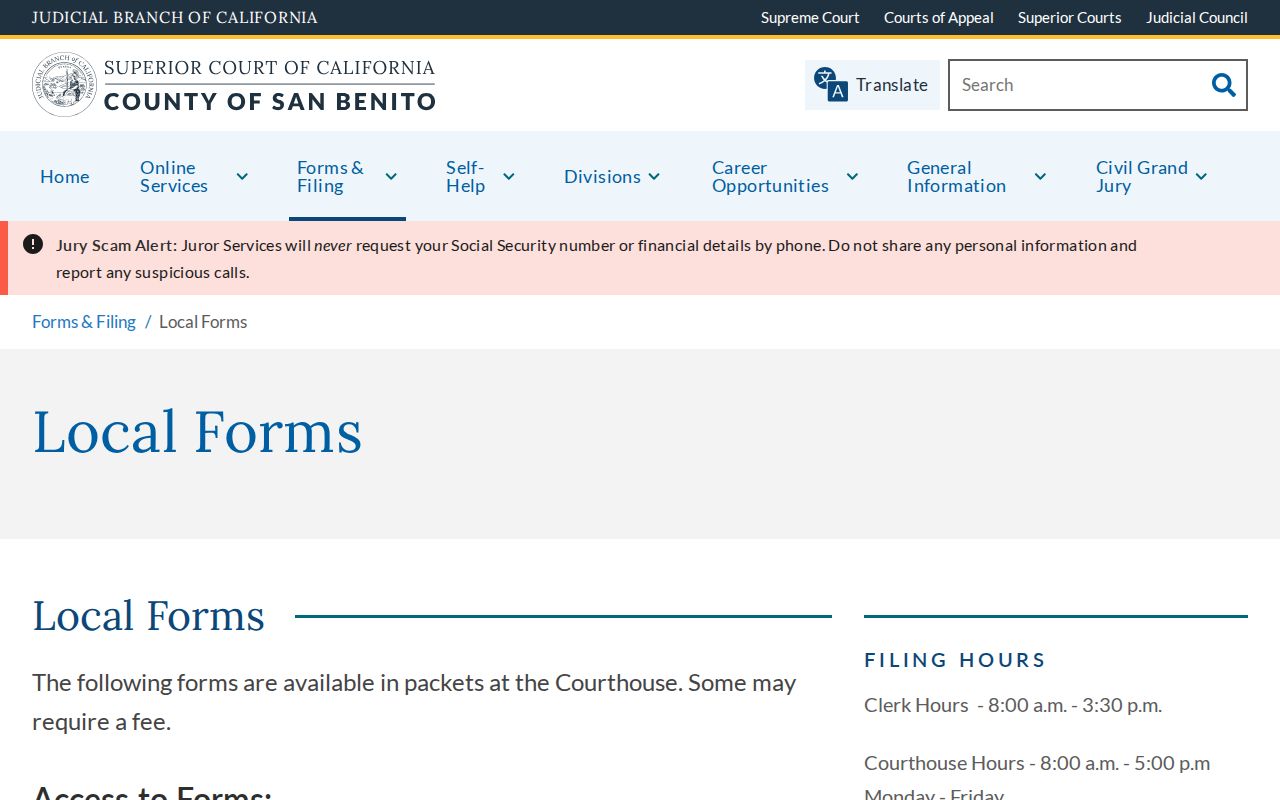
That local form is the bridge from a portal lead to a clerk-performed search or copy order. Keep the case number, requested document names, and return address together. A precise request reduces the risk that the clerk searches the wrong San Benito County case.
| Name search | $15 per name when the search takes more than ten minutes |
|---|---|
| Copies | $0.50 per page |
| Certification | $40 per document |
| Off-site retrieval | $15 when an older file must be retrieved |
| Recorded proceeding | $10 deposit for each audio transcript supplied on USB |
What the Case File Shows
A San Benito County criminal case file follows the prosecutor's filed charges and the court's response. It does not simply repeat the allegations recorded at arrest. The register of actions, also called a docket, gives a dated list of filings and events. A minute order records what occurred at a hearing. The disposition identifies the outcome, such as dismissal, conviction, or acquittal.
| Case Number and Court | The court's unique identifier and the San Benito County division holding the matter. |
|---|---|
| Charging Document | The complaint, information, or indictment stating charges filed in court. |
| Docket Entries | A chronological register of filings, hearings, and judicial actions. |
| Hearing Dates | Past calendar events and scheduled appearances. |
| Disposition and Judgment | The result of each filed charge and the formal judgment. |
| Sentence and Conditions | Custody, fines, restitution, probation, and other orders when applicable. |
For a focused review, ask for the charging document, relevant minute orders, disposition, judgment, and sentencing order. Those papers usually answer more than a long stack of routine notices. A certified copy adds the clerk's attestation that the copy is official.
San Benito Electronic Document Limits
Remote case data and remote document images are not the same service. The California Courts electronic-record rules explain that Rule 2.503 restricts remote electronic access in sensitive case categories. San Benito County permits named parties and attorneys of record to seek electronic file access after identity checks. Attorneys provide one government-issued photo ID. Parties provide two forms of identification, including one government-issued photo ID.
The statewide explanation is shown below because it clarifies why courthouse access can be broader than a public web view.
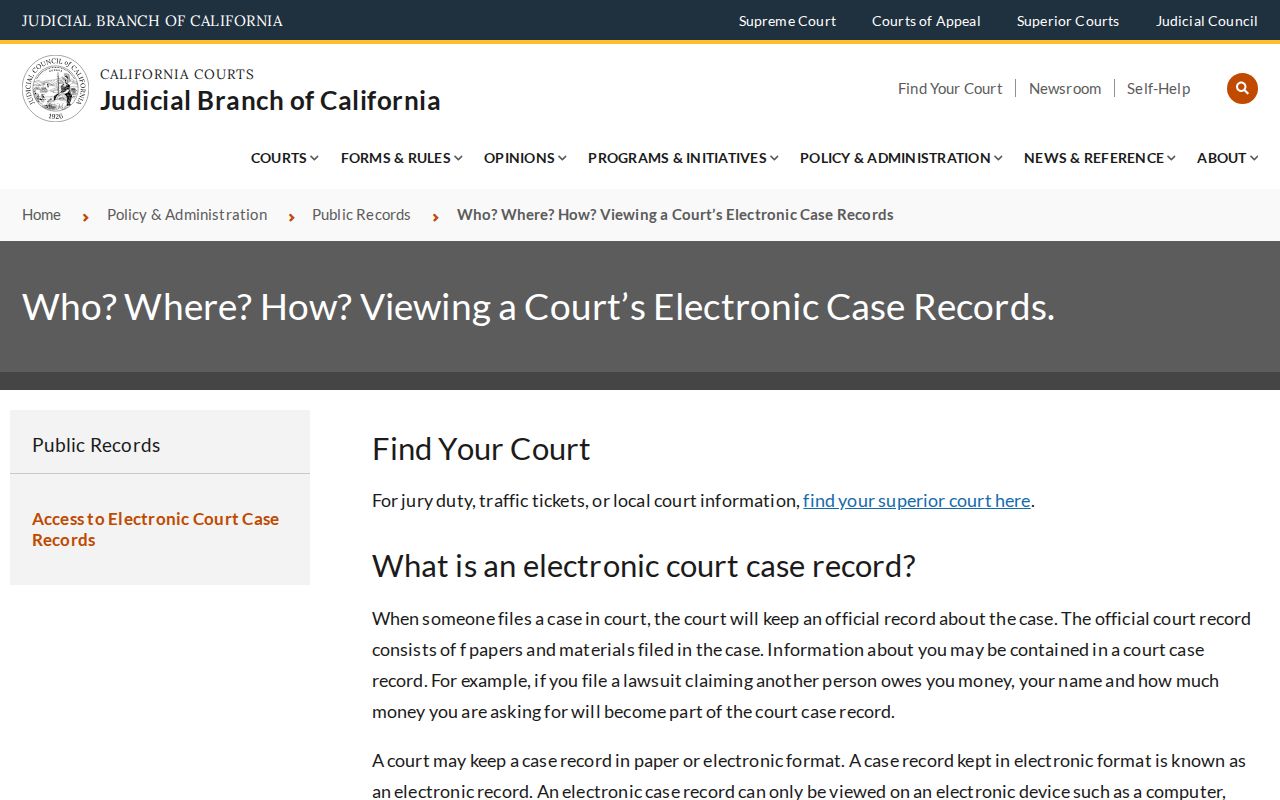
The practical result is simple: a docket hit does not guarantee that the public can open each filed document from home.
Stages of a Criminal Case
A San Benito County case begins in court when the prosecutor files charges. At arraignment, the defendant hears the charges and enters a plea. Pretrial events can include motions, discovery disputes, and settlement talks. The case then reaches a plea or trial, followed by a disposition. Sentencing occurs after a conviction, though some disposition and sentencing events may be recorded together.
Case flow: Charges Filed › Arraignment › Pretrial › Plea or Trial › Disposition › Sentencing
An arrest may precede this sequence, but it is not one of the court-file stages required to prove a filed case. The San Benito County arrest history may show booking details that never become a charge. The court record supplies the later answer.
Reading San Benito Case Outcomes
Compare the charge at filing with the disposition for that same count. A dismissal means the court ended that charge without a conviction on it. An acquittal is a not-guilty result after trial. A conviction follows an accepted guilty or no-contest plea or a guilty verdict. A sentence states what the court ordered after conviction. Do not treat the first charge named in a docket as the final result.
San Benito County minute orders can fill gaps between those points. They may record a plea change, continuance, warrant action, or sentencing terms. If the portal's short label is unclear, request the related minute order or judgment from the clerk. That document-first approach avoids guessing at abbreviations or assuming that every count ended the same way.
Older San Benito Court Files
An older San Benito County case may be indexed yet stored off site. Use the Research and Copy Request Form and describe the person, case number if known, date range, and documents needed. The official fee inventory lists a conditional $15 off-site retrieval charge. A broad name search can also trigger the $15 search fee when staff time exceeds ten minutes.
Ask the clerk to confirm cost before mailing payment when the page count or storage status is unknown. A precise request saves staff from pulling material that does not answer the question. Historical research may call for the complaint, register of actions, judgment, and final minute order rather than every paper in the file.
Access and Restrictions
California court records carry a presumption of access, but that rule has firm limits. Juvenile files, sealed matters, confidential records, victim-identifying details, and some investigative material may be withheld or redacted. Penal Code section 11105 separately restricts California DOJ summary criminal history. It does not turn a court clerk into a public RAP-sheet provider.
A case absent online may still have a public paper component. Ask the San Benito County Criminal Division whether the file exists, whether a public index entry can be confirmed, and which records may be inspected or copied. Staff cannot give legal advice, but they can explain clerk procedures. Sealing and post-conviction relief may also change what appears, so verify any result with the official court record.
The court's online services page groups calendars, eFiling, payments, eService, and transcript requests.
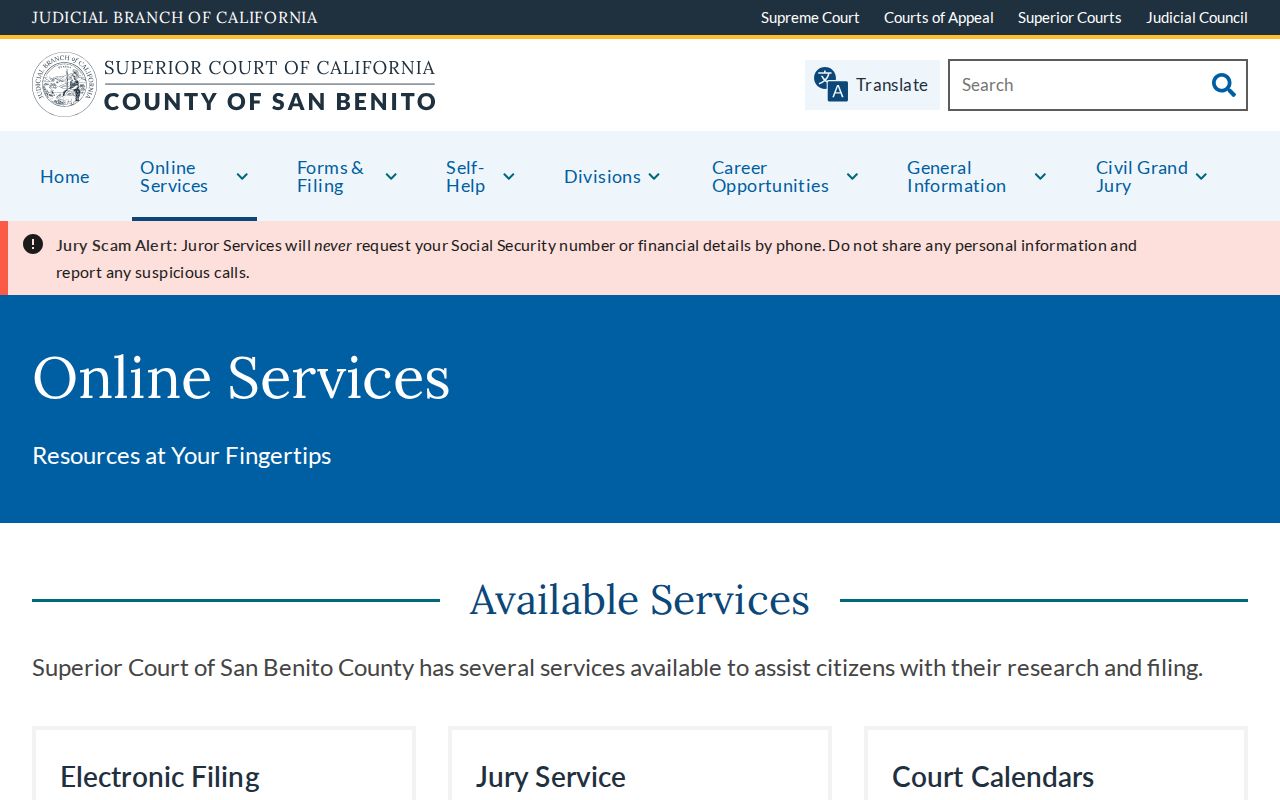
Those tools serve different tasks and do not replace a certified criminal case copy from the clerk.